Mastering
fluorescence correlation spectroscopy
A practical handbook for FCS and FCCS
Understand molecular diffusion, binding, concentration, and complex formation - in solution, at single-molecule sensitivity
Discover everything you need to understand FCS and FCCS and use them to advance your research
This practical handbook brings together the core principles, experimental workflows, and analytical strategies behind fluorescence correlation spectroscopy and fluorescence cross-correlation spectroscopy.
Designed for researchers at every stage – from newcomers to experienced users – it explains how FCS and FCCS can be used to quantify molecular diffusion, absolute concentration, biomolecular interactions, complex stoichiometry, aggregation, and ternary complex formation in solution.
Inside, you’ll find:
- Clear, accessible explanations of FCS, FCCS, autocorrelation, cross-correlation, confocal volume, and structure factor correction
- Practical descriptions of what FCS and FCCS data look like, including serial dilution and ternary complex formation examples
- Guidance on key experimental considerations, including sample concentration, background correction, spectral leakage, detection volume overlap, and triplet states
- Application-focused case studies across antibody affinity screening, ternary complex characterisation, extracellular vesicles, nanomedicine, protein aggregation, phase separation, and therapeutic mechanism of action studies
- Comparisons to complementary techniques such as SPR, DLS, mass photometry, cryo-EM, NMR, and smFRET, helping you understand when – and why – FCS or FCCS may be the right tool
Download this guide if you want to:
✓ quantify biomolecular interactions in solution without surface immobilisation
✓ measure absolute concentration, diffusion, brightness, and complex formation at single-molecule sensitivity
✓ explore binding, aggregation, stoichiometry, and ternary complex formation in native-like environments
What questions does the handbook answer?
- What is FCS?
- What is FCCS?
- How do autocorrelation and cross-correlation functions work?
- What is the confocal volume, and why does it matter?
- What does FCS data look like?
- What does FCCS data look like?
- How can FCS be used to quantify concentration and diffusion?
- How can FCCS reveal biomolecular interactions and complex stoichiometry?
- What are the key considerations for FCS and FCCS experiments?
- How do FCS and FCCS compare with SPR, DLS, mass photometry, cryo-EM, NMR, and smFRET?
- What applications can FCS and FCCS unlock in life sciences and drug discovery?
Want to know more about bringing dynamic single-molecule techniques to your benchtop?
Biology happens when individual molecules interact – in solution, in motion, and often in fleeting moments that determine function.
FCS and FCCS capture these moments by monitoring biomolecular diffusion, giving researchers direct access to absolute concentration, binding stoichiometry, molecular brightness, and real-time interaction dynamics that bulk or immobilised methods may miss.
Whether you want to move beyond surface-based artefacts, study compounds in native-like environments, or unlock deeper insights into complex systems – from nanoparticle loading to early-stage protein aggregation – this handbook is designed to support you.
Our benchtop tools:
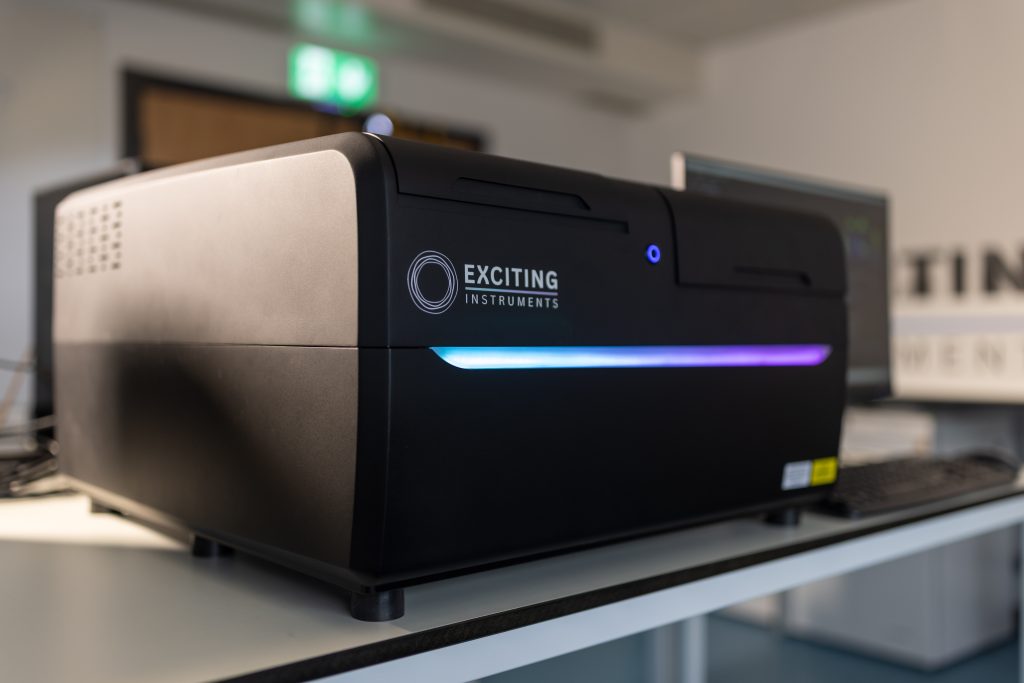
- Are incredibly easy to use – no dark room, optical table, laser-safe room, or custom-built setup required
- Are compact enough to fit directly into your existing lab infrastructure
- Enable solution-based FCS, FCCS, and single-molecule workflows with minimal changes to existing experiments
- Combine intuitive acquisition with powerful PhotonFit™ analysis workflows for confocal volume calculation, FCS analysis, and FCCS interpretation
- Help researchers generate publication-ready data without needing years of specialist optical expertise