This practical handbook brings together the essential principles, experimental workflows, and analysis strategies behind modern fluorescence correlation spectroscopy (FCS) and fluorescence cross-correlation spectroscopy (FCCS).
Written for researchers at all levels – from first-time users to experienced practitioners – it provides the knowledge needed to confidently measure molecular diffusion, biomolecular interactions, aggregation, and complex formation with single-molecule sensitivity.
What’s inside the handbook
Clear explanations of core concepts, including autocorrelation, cross-correlation, confocal volume calibration, structure factor correction, and concentration analysis
Step-by-step insights into how FCS and FCCS experiments work, how fluorescence fluctuations are detected, and how highly sensitive measurements are achieved in solution
Practical examples and case studies showing how FCS and FCCS reveal binding interactions, oligomerisation, phase separation, diffusion behaviour, and ternary complex formation
Comparisons with complementary biophysical and structural biology techniques,
highlighting when and why FCS or FCCS is the right toolGuidance on experimental optimisation and troubleshooting, including concentration selection, spectral leakage correction, triplet-state effects, and improving data quality
Download this guide if you want to:
✓ add a rapid, solution-based method for studying molecular interactions and dynamics
✓ complement ensemble and structural techniques with highly sensitive single-molecule measurements
✓ gain deeper mechanistic insights into biomolecular behaviour and complex formation
Everything you need to understand and apply single-molecule FRET
This practical guide distils the essential principles, experimental workflows, and analysis strategies behind modern single-molecule Förster Resonance Energy Transfer (smFRET).
Written for researchers at all levels – from first-time users to experienced practitioners – it provides the knowledge needed to generate reliable smFRET data and interpret it with confidence.

What’s inside the handbook
Clear explanations of core concepts, including FRET efficiency, stoichiometry, ALEX, burst analysis, and accurate FRET correction
Step-by-step insights into how confocal smFRET works, how single molecules are detected, and how true single-molecule sensitivity is achieved
Practical examples and case studies showing how smFRET reveals structural heterogeneity, conformational dynamics, and nanoscale distance changes
Comparisons with complementary single-molecule and structural biology techniques, highlighting when and why smFRET is the right tool
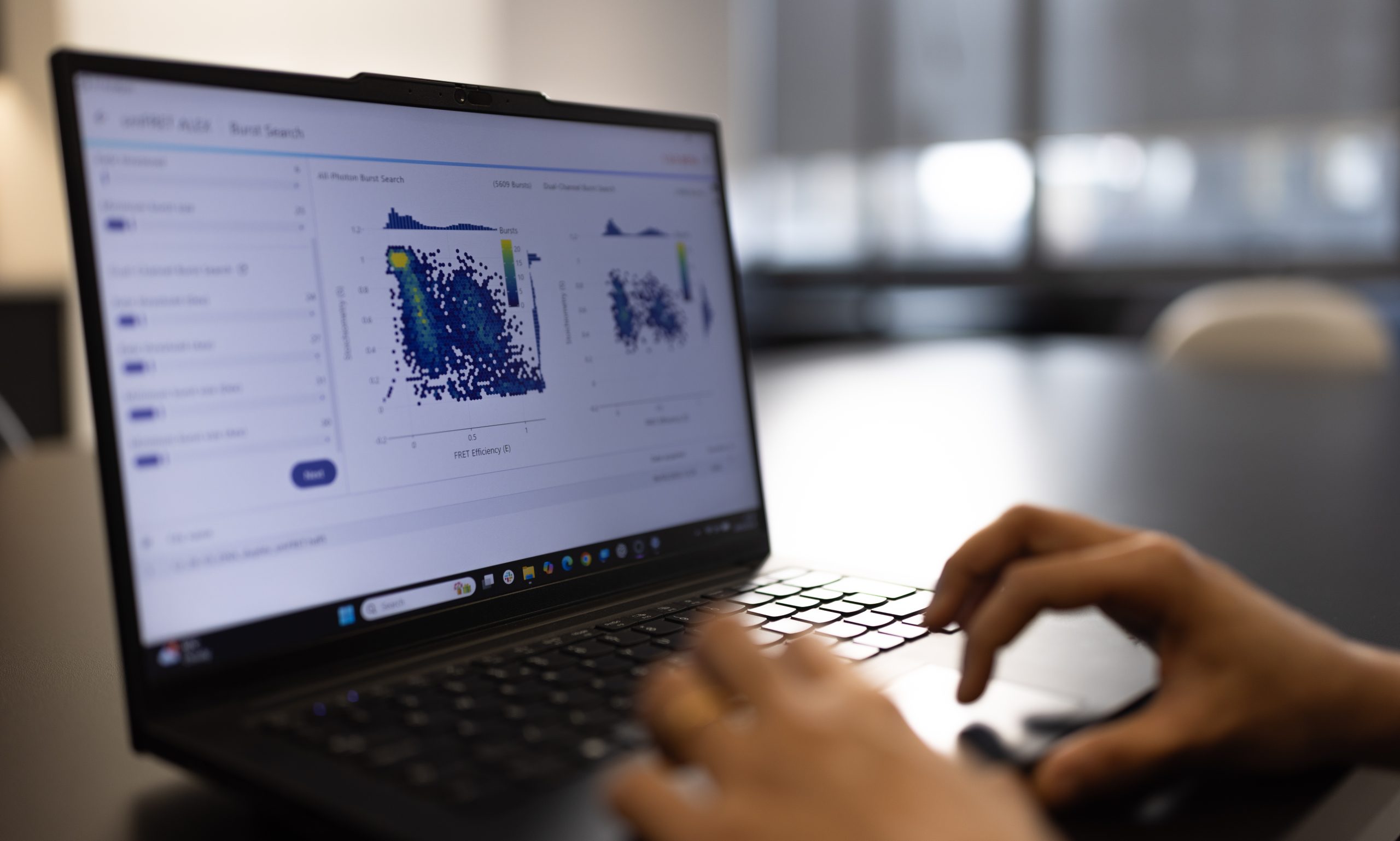
Guidance on advanced analysis methods such as E–S plots, burst search strategies, and correction-factor estimation for high-precision distance measurements
Download this guide if you want to:
✓ add a fast, solution-based method that resolves conformational changes at the single-molecule level
✓ complement static structural techniques with dynamic data
✓ gain deeper functional insights and explore new biological questions