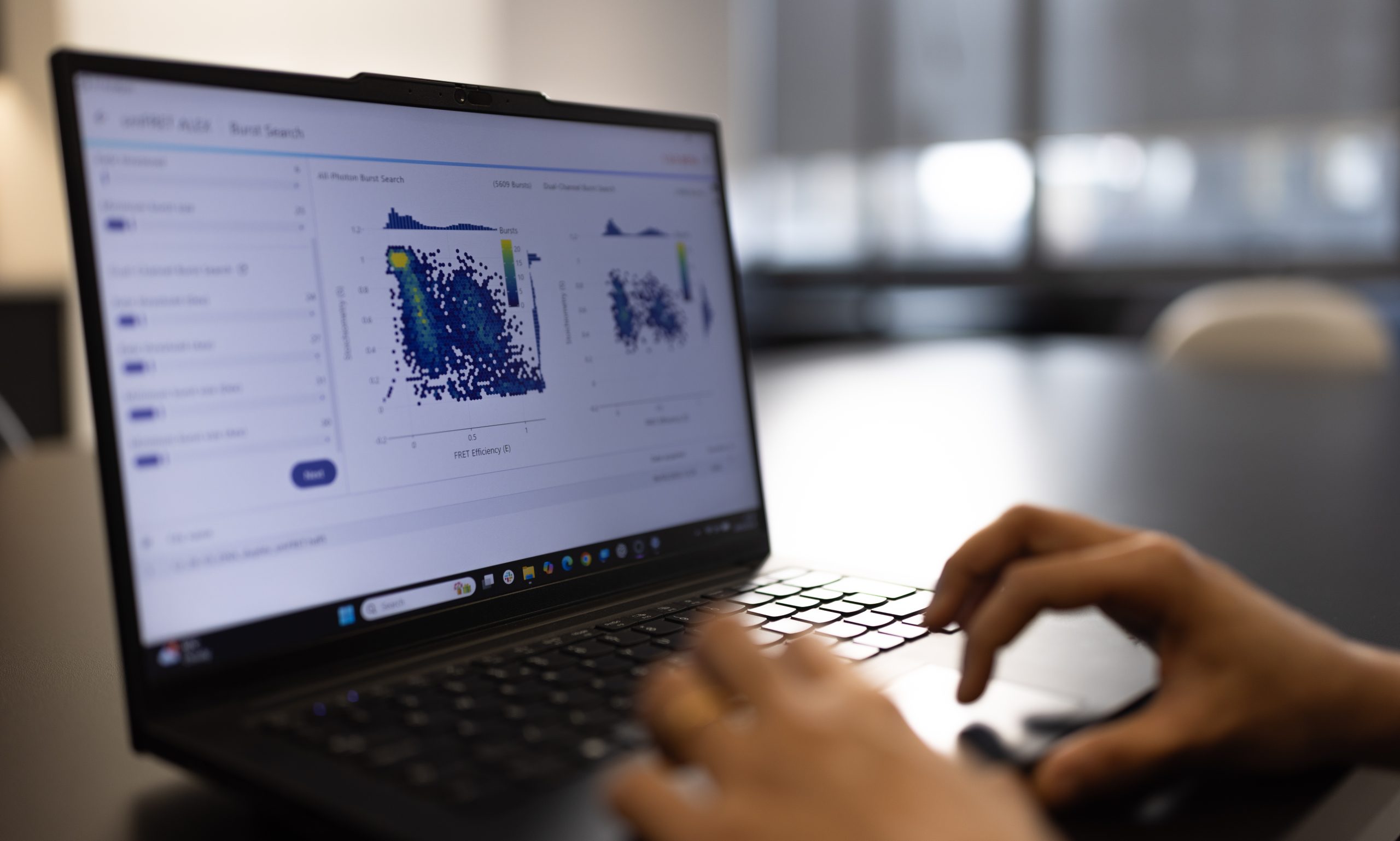
In this technical note, we explore several key components of a confocal FRET experiment that ensure single-molecule sensitivity and accurate determination of FRET efficiencies, taking into account the influence of inefficient labelling of target molecules and photophysical artefacts. Ensuring these factors are corrected during data acquisition and analysis allows resolution of complex subpopulations, conformational changes and nanoscale measurements that can be reported with confidence.
Overview of this application note:
- How confocal volumes can achieve single-molecule sensitivity
- The use of alternating laser excitation (ALEX) and burst searching to identify doubly labelled molecules and photophysical artefacts
- How accurate FRET correction is performed using ALEX

Figure 1 – Confocal volume for smFRET
Single molecules diffuse through a confocal volume formed by focusing lasers to a near diffraction-limited spot. Lasers are alternated rapidly (20 KHz) to ensure each molecule experiences multiple periods of donor and acceptor excitation, respectively.