Cell-free expression of proteins offers a wide range of benefits, from speed and ease to high control over the reaction conditions. Real-time quantification of protein concentration can be measured using FCS in a purification-free method, as demonstrated in new data from Laurence et al. from the Lawrence Livermore National Laboratory.
In an application note produced in collaboration with the authors, we demonstrate how FCS was performed on the EI-FLEX to characterise cell-free protein synthesis of YFP-CopB, a fusion of Chlamydia Outer Protein (Cop) B and Yellow Fluorescent Protein (YFP).
Key messages from this work:
- Cell-free synthesis of the YFP-CopB fusion protein was measured using FCS on the EI-FLEX over a 10-hour period
- Calculation of the confocal volume was performed using Cy3B, a common dye with a known diffusion coefficient
- Autofluorescence of the cell-free lysate can be distinguished from the photons emitted by the YFP-CopB fusion protein under 520 nm laser excitation
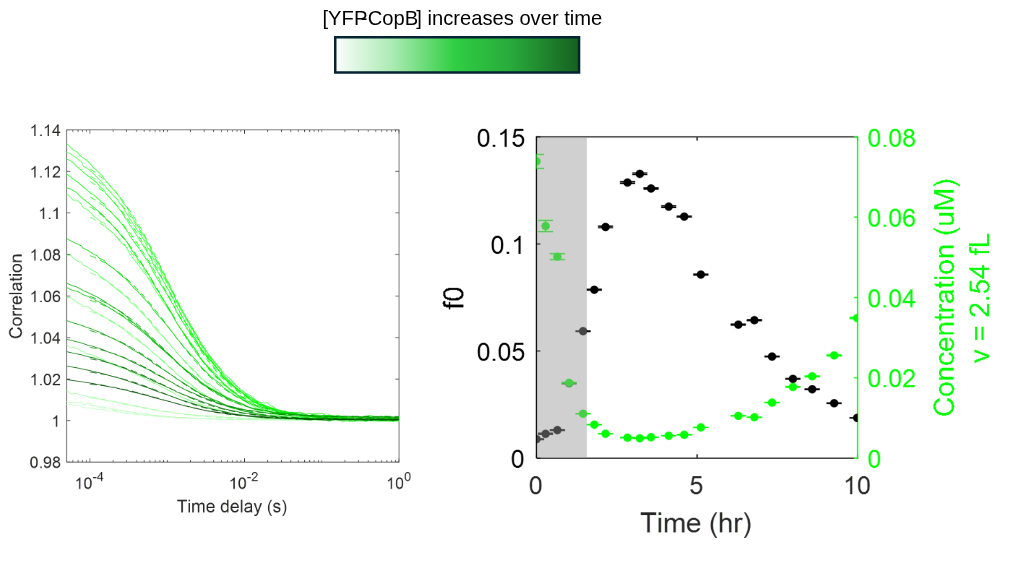
Figure 1 – YFP-CopB protein expression in ClearColi cell-free lysate monitored over time using the EI-FLEX
(Left) Correlation versus time delay from FCS measurements of YFP-CopB expressed in CC lysate. Correlations (green) represent separate measurements taken at intervals over ten hours. Light green correlations represent early time points. Dark green correlations represent data taken at a later point in time.
(Right) Amplitude (black) and concentration (green) versus time. Grey shading indicates where early background fluorescence dominated. Concentrations were calculated from the measured amplitude and previously calibrated confocal volume of 2.54 fL.
Modified figure from publication by Laurence et al.1