Developing next-generation biotherapeutics, such as bispecific antibodies, antibody combination cocktails, molecular glues, and PROTACs, requires evaluating multi-protein interaction dynamics that binary assays cannot directly capture. Using the clinically validated dual-HER2 antibody combination (trastuzumab and pertuzumab), this application note demonstrates how Fluorescence Cross-Correlation Spectroscopy (FCCS) provides direct, solution-phase quantification of ternary assembly, cooperativity (α), and kinetic stabilisation (koff) in microplate formats1. FCCS measures the cross-correlation between two fluorescent species; in the case of trastuzumab-HER2-pertuzumab, cross-correlation will only occur when HER2 bridges the two antibodies, forming a ternary complex.
Overview of this application note:
- FCCS directly quantifies ternary complex formation using cross-correlation, identifying a cooperativity factor of 3.1 for the complex and slower dissociation rates compared to binary species, indicating favourable stabilisation
- Competitive chase FCCS assays confirmed that each of the antibodies binds different epitopes, but dissociation kinetics revealed that pertuzumab may perturb some trastuzumab-HER2 complexes
- FCCS can also be used to derive KD values for individual antibody-HER2 complexes
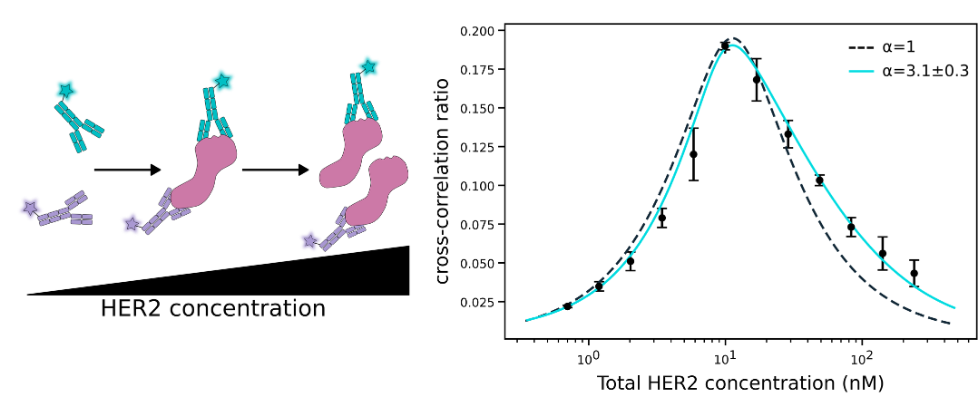
Figure 1 – FCCS data produces a characteristic hook plot for ternary complexes
As HER2 concentration increases, ternary complex formation also rises until binary species begin to dominate. FCCS data directly captures this hook effect, while also identifying a positive cooperativity value of 3.1.
Figure adapted from Mueller et al., 20261