In this application note, we showcase the use of single-molecule Förster Resonance Energy Transfer (smFRET) on the EI-FLEX in the development of a surface-immobilised, pH-dependent DNA nanoswitch. Dynamic DNA machines, like the DNA nanoswitch discussed here, can switch between conformational states in response to environmental conditions.
D’Rozario et al. used solution-based smFRET in tandem with circular dichroism spectroscopy to quantify the conditions required for conformation switching of a DNA nanoswitch prior to surface immobilisation.
Overview of this application note:
- Single-molecule FRET can rapidly resolve open, closed and mixed configurations of a DNA triplex nanoswitch at different pH values using picomolar concentrations
- smFRET can be used to calculate the solution-phase dissociation (pKa) pH
- Surface immobilisation of the nanoswitch does not affect pH-dependent behaviour
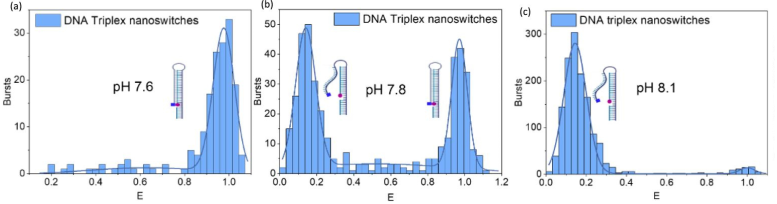
Figure 1 – smFRET demonstrates a pH-dependent shift in nanoswitch conformation
a) High-FRET population at pH 7.6 (closed state)
b) Double population at pH 7.8 (mixed conformations of open and closed states)
c) Low-FRET population at pH 8.1 (open state)