Alex Payne-Dwyer is a Senior Technical Specialist in the Bioscience Technology Facility within the Department of Biology at the University of York. He sat down with Science Writer Charlotte Wynn from Exciting Instruments to offer his experiences of running the EI-FLEX in a core facility, with input from Facility Director Peter O’Toole.

Exciting Instruments: Thank you for sitting down with us. First of all, could you tell us about the Bioscience Technology Facility and the sorts of instrumentation you have there?
Alex Payne-Dwyer: Thank you so much for the invitation to talk. We have a lot of instruments in the facility, and we’re very glad that the EI-FLEX is one of those. I coordinate not only the EI-FLEX, but also the ecosystem of single-molecule instruments around it. I work between the two subparts of the facility: the imaging side, which involves single-molecule imaging, such as spinning disc microscopy, alongside the molecular interaction part of the facility. This includes instruments commonly seen in a biochemistry lab: SPR, ITC, and standard worktop plate readers. This breadth enables me to branch across users and projects, all the way from in-cell imaging of single molecules to looking at the individual domains of proteins and DNA interactions.
Exciting Instruments: That’s the beauty of core facilities, isn’t it? They can serve lots of different specialities and research projects. So, which departments or research groups are currently using the EI-FLEX? And what has surprised you most about the variety of these applications?
Alex Payne-Dwyer: It really has been a variety of applications. The reason that we have an EI-FLEX is because as a facility, we spoke to a variety of people on and off campus from different departments, including the lead investigator, Dr. Steve Quinn from Physics, who then gathered them together as a user group. The most confident pioneer groups have been the structural biologists. Single-molecule FRET is one of the core techniques for the EI-FLEX and provides an inter-dye ruler.
You can see biomolecular dynamics as well as the distances, which structural biologists really like as a complementary technique to things like cryo-EM and crystallography. But we also have growing interest from other, really diverse applications. We have people who are invested in synthetic biology or biological engineering. For example, we’ve got projects on the in-solution motion of molecular motors. We are also talking to cell biologists and biomedical scientists who are interested in the motion of vesicles or extracellular signalling; things like the fusion of vesicles or leakage of contents that you could imagine being used for drug delivery and therapeutics.
Ultimately, in the core facility, we see a real broad range of use cases for the EI-FLEX, from basic physics all the way up to biomedicine.
“Ultimately, in the core facility, we see a real broad range of use cases for the EI-FLEX, from basic physics all the way up to biomedicine.”
Exciting Instruments: That’s fantastic to hear. It will be really interesting to see what single-molecule data comes out from all those projects. Have there been any particularly unique or challenging projects that the EI-FLEX has helped move forward?
Alex Payne-Dwyer: We’ve had a few cases like this already, but one that really did make a critical difference was for a project looking at hairpin structures. Hairpins within mRNAs can undergo subtle structural changes that have incredibly large downstream effects on things like protein translation.
For example, in viral translation, angstrom-scale changes can alter the fate of a particular protein; viral capsid proteins are translated from the same sequence, but depending on the specific RNA hairpin structure, the resultant proteins will be different.
This process is also hugely dependent on the local conditions, from temperature and salinity to pH and interactions with co-factors. Chris Hill’s and Steve Quinn’s groups here at York recently had some excellent work published on this. You can imagine adding something like a biologic or a small molecule to change that process.
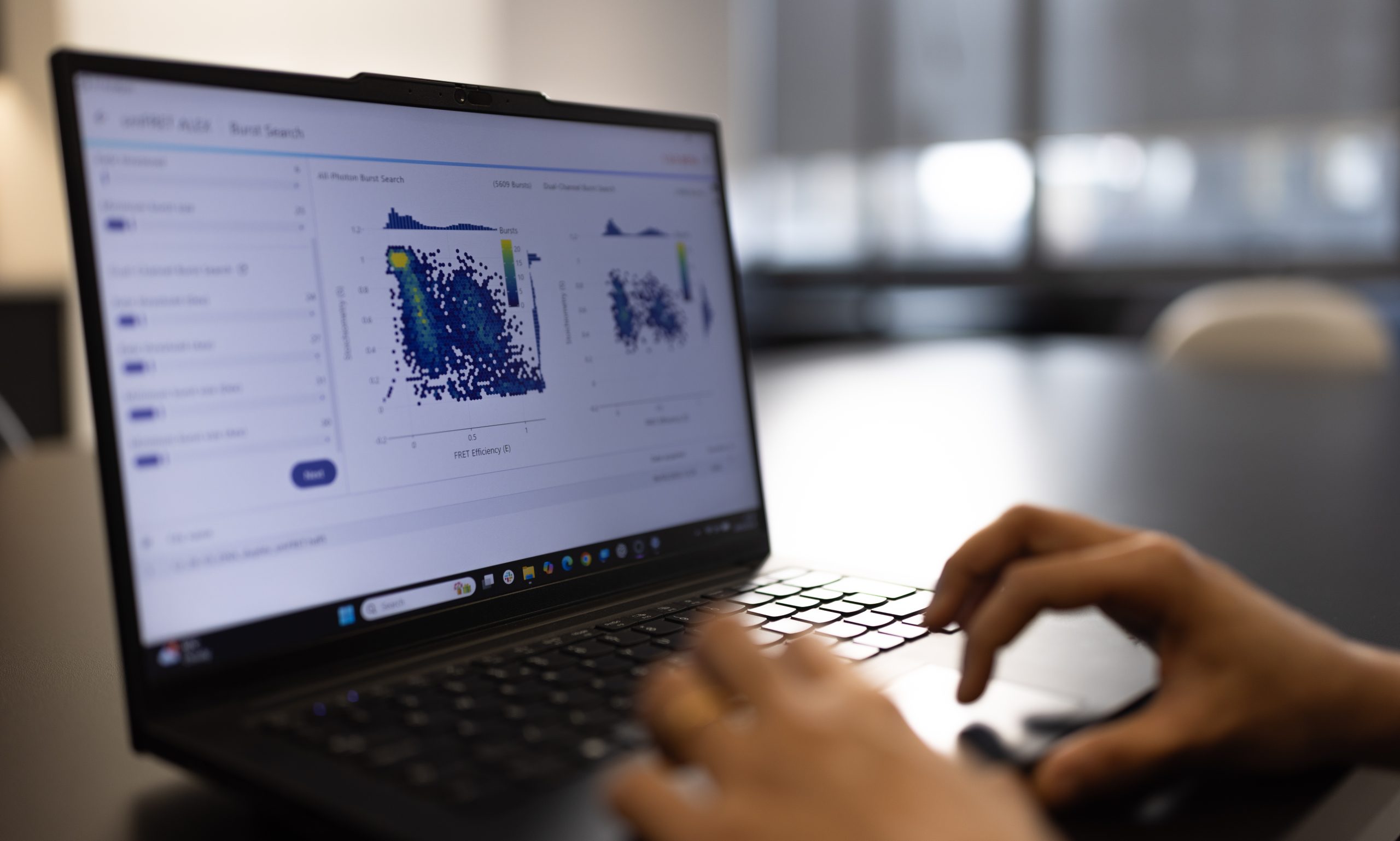
The project was incredibly challenging before we began using the EI-FLEX. Although we could correctly label everything with fluorescent probes, and techniques like fluorescent imaging have the required sensitivity and specificity, they don’t have the necessary temporal and spatial resolution. The combination of FCS and smFRET on the EI-FLEX enabled us to capture these fast, small-scale transitions. Also, for scientists who aren’t structural biologists, there’s a real barrier to entry for setting up a lengthy cryo-EM workflow. In those cases, smFRET can be really complementary.
Exciting Instruments: Amazing. One of the real things that we’re trying to champion at Exciting Instruments is that we’re not here to replace well-established structural techniques, but rather, to add a complementary technique that is also accessible.
As you well know, advanced biophysical instrumentation often requires dedicated expertise and infrastructure to run. How long does it typically take a new user to get trained and to run their own samples independently on the EI-FLEX?
“I can train someone who’s never used a microscope before or had any grounding in fluorescence techniques in a couple of hours. Certainly, much shorter than most instruments.”
Alex Payne-Dwyer: You’re absolutely asking the right question. The critical thing is not whether someone can do it; it’s the time it takes to complete. We all know projects and contracts don’t last forever.
Typically, when I train users on new instruments, I always ask about their scientific background, as this dictates the length of training they’ll need, such as whether they’ve had experience on a microscope before. With the EI-FLEX, it’s different. That question factors into conversations around how they would prepare their samples, but it doesn’t affect the length of training.
I can train someone who’s never used a microscope before or had any grounding in fluorescence techniques in a couple of hours. Certainly, much shorter than most instruments.
Exciting Instruments: That’s great – are we talking about PhD students and postgrads, or is this at the undergraduate level as well?
Alex Payne-Dwyer: At the moment, it’s mostly PhD students who are using the EI-FLEX routinely. They’ve been trained, and they use the instrument independently, day in, day out. They’re superusers, essentially.
However, it is also absolutely accessible for undergraduate project students, either as groups or as individuals. In fact, we have publications out for review right now with summer interns as co-authors, which just shows how straightforward it is to use. We have people using the EI-FLEX for one-off projects, but there are also key groups that use it frequently for anything from quality control to these more systematic structural analyses. So, there’s a broad range of projects that you can use it for.
We have people coming in as a one-off. They can get a full dataset in one day, which forms the preliminary results they need for a grant proposal. We also run training courses for people from a variety of different scientific backgrounds.
Exciting Instruments: As a core facility manager, your time sounds like it is split in many different ways. How has the installation and running of the EI-FLEX impacted your daily workload? I’m thinking in terms of things like troubleshooting, calibration, and hands-on support.
Alex Payne-Dwyer: The first thing we think about when we’re considering resource allocation is how much time and space does it need? How much money is required to run it? For the EI-FLEX, it’s a benchtop instrument, so it sits nicely alongside standard equipment.
“It’s also really time-efficient to use around other commitments. The PIs like using it because they have meetings while it’s running. I’m no different – I typically set things up for maybe 15-20 minutes, do my dilutions and the laser calibration, and then swap the samples between meetings. If I were on site right now, I’d be running samples while we speak.”
It’s also really time-efficient to use around other commitments. The PIs like using it because they have meetings while it’s running. I’m no different – I typically set things up for maybe 15-20 minutes, do my dilutions and the laser calibration, and then swap the samples between meetings. If I were on site right now, I’d be running samples while we speak.
As someone who has some experience in building custom biophysics instruments, running the EI-FLEX is so much less maintenance than building your own or training a new PhD student to use that specific instrument. With the EI-FLEX, you will always be able to use it wherever you are in the world.
If you go on a secondment or to a different core facility, you can use the EI-FLEX. The acquisition and analysis software packages make it much easier to get results as well.
All of this makes a big difference to our external customers too. They might be visiting for the day with storage-sensitive samples. Do we really want to spend time and effort snap-freezing those proteins when actually, we’ve got everything good to go? They can arrive at 10:00 in the morning, and we can get a whole dataset from just that one visit.
“As someone who has some experience in building custom biophysics instruments, running the EI-FLEX is so much less maintenance than building your own or training a new PhD student to use that specific instrument. With the EI-FLEX, you will always be able to use it wherever you are in the world.”
Exciting Instruments: That’s a win-win for everyone! So, for a core facility, cost-benefit really matters and communicating this to university leadership and grant bodies is vital. We’ve touched upon this already, but how have you demonstrated the long-term ROI for the EI-FLEX in your facility?
Alex Payne-Dwyer: One of the great things about core facilities is that they’re generally set up to make a straightforward case to university management and to the direct users – it’s all around the use case and the shared open access. In our case, we split this across multiple departments: Biology, Chemistry, and Physics, Engineering and Technology, serving users not only in the faculty, but across the whole university and external users as well. So, we didn’t need to invent any new infrastructure to do that as part of our regular business.
The EI-FLEX also complements the other equipment in the lab and the wider facility. When you’re talking to people about one instrument, you have to consider the trade-offs – it doesn’t matter what biophysical technique you use, it’s never going to be a one-shot.
The two main routes from which we see new users are firstly from those that already use the confocal FCS/FCCS and Zeiss Dynamics Profiler (which cell or developmental biologists use), as well as the ecosystem of single-molecule instruments, which I advertise and administer regionally, such as the LUMICKS C-Trap and Refeyn Mass Photometer (which molecular biologists and biochemists tend to use).
All of the above is cost-recovered and on service contracts, which gives everyone confidence because we know we’re sufficiently supported – we know this capability is going to be sustainable over many years, much longer than the lifetime of any one project.
We are here as a central resource to signpost users and to train them to ensure that they get value for money in their own projects. So, it’s not only the university’s return on investment, but it’s also better value for the users as well.
Exciting Instruments: If a core facility manager called you tomorrow asking if the EI-FLEX is worth the bench space and the budget, what would you tell them?
Alex Payne-Dwyer: In a word: yes. But I’d tell them to get the EI-FLEX Pro, as from what we’ve heard, it’s even better! I’ve spoken already to quite a few facility staff at our demo events, alongside some industrial commercial users and scouts – they’re really surprised how simple it is to get consistent and smart-looking data almost on the fly. That’s valuable not just to our existing academic users, but to the people who would potentially run it in the core facility as well.
“Once you have something labelled, you’re going to get data. Even if it doesn’t ‘work’, it will then steer you to what you try the next day. You’re always going to learn something.”
The footprint is minimal and is always a great talking point for visitors to the facility. The price point is fairly competitive, so donʼt skimp on including a service contract, as it will be used a lot! Also, the recovered costs can still be affordable for early-career researchers, especially considering the strategic long-term support that your facility and the company can offer.
Once you have something labelled, you’re going to get data. Even if it doesn’t ‘work’, it will then steer you to what you try the next day. You’re always going to learn something.
Exciting Instruments: That sort of iterative agility is really valuable and not typically commonplace for other structural and biophysical methods. It’s definitely something we’re excited about.
That brings me to my final question: Do you have any advice for how they can get the most out of an EI-FLEX in a core facility?
Alex Payne-Dwyer: Speak to the company – their people are awesome, serious about the science, and very willing to engage on testing and applications, as well as share training materials. To acquire an instrument, there are really excellent high-level funds, such as EPSRC Strategic Infrastructure, BBSRC ALERT, etc. These are well-known to facilities, are the right size for this kind of capability, and they prioritise securing service provision while valuing core expertise. At our facility, we also help our users to secure dedicated access awards that cover our costs, such as the RMS/UK Bioimaging Fund, EuroBioimaging and the ITSS Equipment Sharing Fund. These can be really helpful for obtaining preliminary results quickly for a larger grant application or fellowship.
We’re really keen to see how many more core facilities take up use of the EI-FLEX. We’re making the most of it.